- Logbook & currency
- 8 minute read
- Updated
- By The FlyFren Team
What Counts as Cross-Country Time? Every 61.1 Definition
Cross-country time has seven definitions in 14 CFR 61.1. Which one applies for logging, private, instrument, commercial, sport and ATP, with examples.
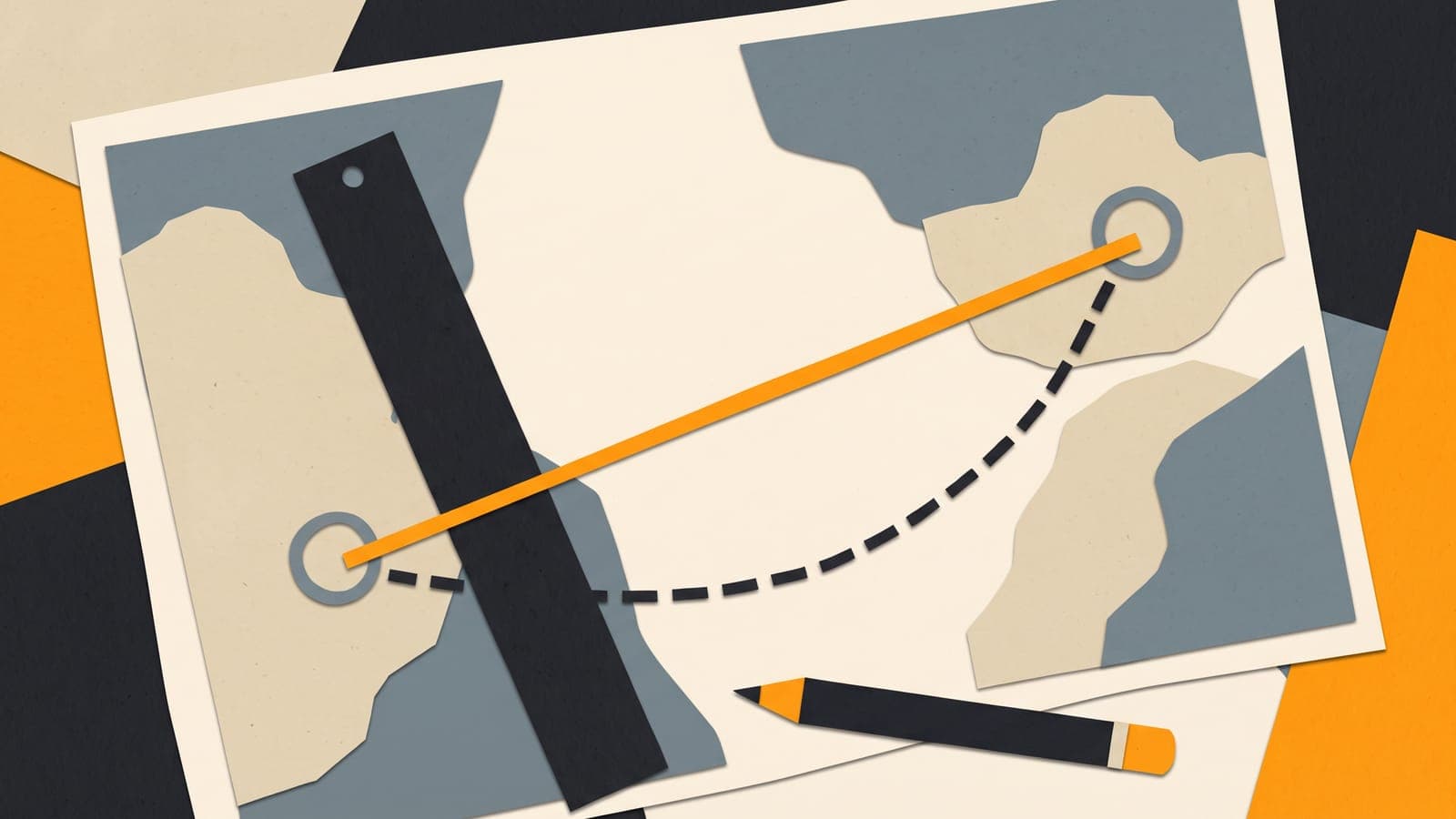
Cross-country time has seven definitions in 14 CFR 61.1, numbered (i) through (vii), and the one that applies depends on what you intend to use the time for. A 30-mile hop to the next airport is cross-country time under the first definition and is worth nothing toward a private, instrument or commercial certificate under the second. Most logbook arguments about this topic are two people reading different paragraphs.
The distances are 50, 25 and 15 nautical miles, all measured in a straight line from the original point of departure. Two of the seven definitions, the airline transport pilot one and the military one, require no landing at all.
Seven definitions, one table
The table below is taken from the definition of "cross-country time" in 14 CFR 61.1 as of October 2026. Every entry except the first requires the flight to be "conducted in an appropriate aircraft" and to involve "the use of dead reckoning, pilotage, electronic navigation aids, radio aids, or other navigation systems."
| Paragraph | Counts toward | Distance | Landing |
|---|---|---|---|
| (i) | Logging only, when no other paragraph applies | None | At a point other than the point of departure |
| (ii) | Private (except powered parachute), commercial and instrument experience, none of it in rotorcraft; recreational privileges under 61.101(c) | More than 50 nm straight line from the original point of departure | Required, at that point |
| (iii) | Sport pilot (except powered parachute) | More than 25 nm | Required |
| (iv) | Sport pilot with powered parachute privileges; private pilot powered parachute rating | More than 15 nm | Required |
| (v) | Any certificate with a rotorcraft rating; instrument-helicopter; recreational privileges in a rotorcraft | More than 25 nm | Required |
| (vi) | Airline transport pilot (except rotorcraft) | More than 50 nm | Not required |
| (vii) | Military pilots qualifying for a commercial certificate under 61.73 (except rotorcraft) | More than 50 nm | Not required |
Paragraph (ii) is the one almost every student and rating candidate lives under. Paragraph (vi) is the one that lets an airline applicant count a flight with no qualifying landing at all, as long as it went more than 50 nm from where it started.
Logging cross-country: any landing somewhere else
Under paragraph (i), cross-country time is time during a flight "conducted by a person who holds a pilot certificate," "conducted in an aircraft," that "includes a landing at a point other than the point of departure," and that uses some form of navigation to get there (61.1).
A student pilot certificate is a pilot certificate; it is the first one listed in 61.5(a)(1). So a student's dual flight to an airport 18 nm away, with a landing, is cross-country time under (i). It is not cross-country time under (ii), and (ii) is what the private pilot experience requirements in 61.109 are written against.
That is the trap. Paragraph (i) opens with "Except as provided in paragraphs (ii) through (vii)." Whenever one of the specific definitions applies to the purpose you have in mind, it displaces the general one. Time that meets only (i) is real, loggable, and useless for a 61.109, 61.65 or 61.129 total.
How is the 50 nm distance measured?
Paragraph (ii) requires "a point of landing that was at least a straight-line distance of more than 50 nautical miles from the original point of departure" (61.1), so the distance is a straight line from where the flight began to where it landed, not the miles flown.
First, "more than 50" means exactly 50.0 nm does not qualify. Pick a destination with margin rather than argue about a tenth of a mile.
Second, the whole flight counts once any landing on it is more than 50 nm from the original departure point. The time flying there, and the time flying home, are both "time acquired during a flight" that includes the qualifying landing. The FAA Chief Counsel confirmed this in the Van Zanen interpretation of December 1, 2009. In its words, the definition "does not require that any one leg of the flight be 50 nm," only that "at least one leg of the cross-country flight, however long by itself, must include a point of landing that is at least a straight-line distance of more than 50 nm from the original point of departure."
Third, legs can be strung together, and the pilot chooses what counts as one flight. The scenario in that interpretation is the one people get wrong. Airport A to Airport B is 20 nm. B to C is 60 nm, but C lies only 40 nm from A. C back to A is 40 nm. Logged as one flight starting at A, none of it is (ii) cross-country, because no landing is more than 50 nm from A. The Chief Counsel's answer was that the pilot "may choose what is considered a flight and what is merely a segment of a flight." Log A to B as one flight with no cross-country, and B to C to A as a second flight: C is 60 nm from B, so the whole second flight is cross-country.
Measure it with a plotter on the sectional or any planning tool that reports the distance between the two airports, not the distance along your route.
The private pilot 150 nm solo cross-country
The experience requirements for a private pilot certificate with an airplane single-engine rating are in 14 CFR 61.109(a). Three of them involve cross-country flying:
- 3 hours of cross-country flight training with an instructor (61.109(a)(1)).
- A night cross-country flight of more than 100 nm total distance, inside the 3 hours of night training (61.109(a)(2)(i)).
- 5 hours of solo cross-country time, including "one solo cross country flight of 150 nautical miles total distance, with full-stop landings at three points, and one segment of the flight consisting of a straight-line distance of more than 50 nautical miles between the takeoff and landing locations" (61.109(a)(5)(i) and (ii)).
Total distance means the sum of the legs, so a 160 nm triangle qualifies on distance as long as one leg is more than 50 nm in a straight line. Full-stop landings means a touch-and-go at the middle airport does not count as one of the three points. And the 50 nm segment is measured between the takeoff and landing locations of that one leg, which is a stricter test than the 61.1 definition applies to the flight as a whole.
Plan the route with full stops at three airports other than the one you left, and the question of whether home counts as a point never comes up. A Part 141 private course sets its long solo cross-country at 100 nm total distance with the same three-landing and 50 nm segment rules (Part 141 Appendix B, section 5(a)(1)).
The solo flying also needs the 61.93 endorsements (AC 61-65K, items A.9 through A.11). Under 61.93(a)(1), a student needs that authorization before any solo flight more than 25 nm from the airport the flight began at, or any solo landing elsewhere.
Instrument, commercial and ATP totals
The instrument-airplane rating requires "50 hours of cross-country time as pilot in command, of which 10 hours must have been in an airplane" (61.65(d)(1)). That is paragraph (ii) time, so the 50 nm landing rule applies, and it must be logged as PIC, which for a private pilot usually means sole manipulator in an aircraft you are rated for (61.51(e)(1)(i)).
The commercial certificate stacks several requirements in 61.129(a). There are 50 hours of cross-country as PIC, at least 10 in airplanes (a)(2)(ii). There is a 2-hour day cross-country and a 2-hour night cross-country, each "of more than 100 nautical miles from the original point of departure" measured as total straight-line distance (a)(3)(iii) and (iv). And there is the long one: "not less than 300 nautical miles total distance, with landings at a minimum of three points, one of which is a straight-line distance of at least 250 nautical miles from the original departure point" (a)(4)(i). Hawaii gets a shorter longest segment, 150 nm, under the same paragraph.
The airline transport pilot certificate needs 500 hours of cross-country time (61.159(a)(1)), and here the definition changes. Paragraph (vi) of 61.1 drops the landing requirement: the flight must go more than 50 nm straight line from the original point of departure, and that is all. Cross-country logged under (ii) also meets (vi), since any flight with a landing more than 50 nm away went more than 50 nm away. The reverse is not true, so keep the two totals separate if you are building toward both.
Sport, rotorcraft and powered parachute distances
Sport pilot aeronautical experience uses paragraph (iii) of 61.1: a landing more than 25 nm straight line from the original point of departure. Rotorcraft of any certificate level, and the instrument-helicopter rating, use paragraph (v), also 25 nm. Powered parachutes, under (iv), use 15 nm.
A helicopter pilot adding an airplane rating is back under paragraph (ii), and 25 nm helicopter cross-countries do not transfer into the airplane total.
How to log it so each column is right
14 CFR 61.51(b) requires, for every flight you log, the date, total time, the "location where the aircraft departed and arrived," the aircraft type and identification, and the conditions of flight. Nothing in the regulation names a cross-country column. The column is yours to define, so define it to match the certificate you are chasing.
A workable scheme for an airplane pilot:
- Cross-country column: only flights with a landing more than 50 nm straight line from the original departure point (paragraph (ii)). This is the number 61.109, 61.65 and 61.129 will be checked against.
- Remarks: the route, every airport where you landed, and the straight-line distance of the qualifying landing ("KXYZ 62 nm from dep"), so the answer is on the page when a DPE asks.
- Short hops with a landing elsewhere: log them normally, note "61.1(i) only" in remarks, and leave the column blank.
- The private long cross-country: write "3 full stop" with the airport identifiers. 61.109(a)(5)(ii) is the paragraph a DPE reads most carefully.
- PIC and cross-country together: the instrument and commercial totals require both, so check that your PIC column agrees with 61.51(e) before counting a dual cross-country toward 61.65(d)(1).
If your logbook software has one cross-country field, it is almost certainly meant for paragraph (ii). The FlyFren logbook is free and imports an exported CSV from ForeFlight, Garmin Pilot or LogTen Pro with a preview before anything is saved, which is a good moment to audit that column. The decision about what belongs in it is still yours. The same discipline carries over to the currency clocks, which also reward a logbook that records the exact fact the regulation asks about.
Before your next checkride, add up the column by hand once and compare it to the software total. If they differ, the column has (i) time in it.
This article is educational and is not a substitute for the current regulations, the AIM, official weather briefings, or instruction from a CFI. Check the current text at the linked sources before you rely on any detail.
- Logged by
- The FlyFren Team
- Pilots and engineers building FlyFren
- Filed under
- Logbook & currency